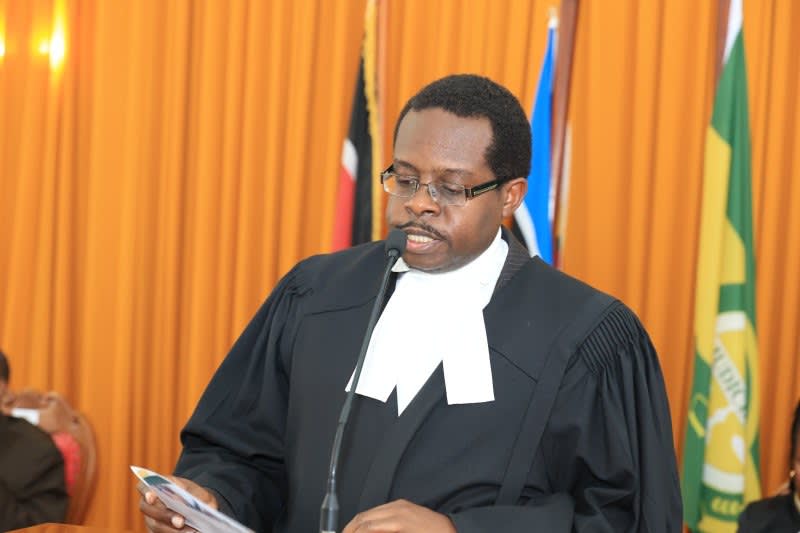
The Law Society of Kenya (LSK) has announced a nationwide boycott of court proceedings on Wednesday, July 22, escalating its standoff with the Judiciary over what it describes as persistent corruption, delays and a lack of accountability in the administration of justice.
In a statement issued on Friday, July 17, LSK President Charles Kanjama said the one-day boycott is intended to "emphasize the seriousness of the concerns raised by members and to call for meaningful institutional interventions that will restore confidence in the administration of justice."
The Society also unveiled an indefinite targeted boycott of courts presided over by judges and judicial officers who have obtained court orders blocking the Judicial Service Commission (JSC) or the Ethics and Anti-Corruption Commission (EACC) from investigating or processing complaints of corruption or misconduct against them.
"The Society shall undertake a nationwide boycott of court proceedings on Wednesday, 22nd July, 2026, intended to emphasize the seriousness of the concerns raised by members and to call for meaningful institutional interventions that will restore confidence in the administration of justice," the statement read.

The move marks one of the strongest actions taken by the lawyers' body in recent years and comes after months of engagement with the Judiciary, which the Society says has failed to resolve longstanding complaints by advocates across the country.
According to the LSK, members have repeatedly raised concerns over allegations of judicial corruption and misconduct, delays in hearing and determining cases, registry inefficiencies, technological failures affecting e-filing, and what it described as ineffective mechanisms for handling complaints against judges and judicial officers.
"Members have expressed concern over allegations of corruption, judicial misconduct, abuse of office and unethical conduct by some judicial officers, which continue to undermine public confidence in the administration of justice," the Society stated.
The lawyers' body further cited delayed rulings and judgments, frequent adjournments, inconsistent case management, and disruptions to the Judiciary's digital systems as among the challenges that continue to hinder access to justice. It also raised concerns over discourteous treatment of advocates in court and inefficiencies in court registries that have delayed processing of documents and release of court-held funds.
Despite reaffirming its support for judicial independence, the Society insisted that independence must be accompanied by accountability.
"The Council remains committed to constructive engagement with the Judiciary and fully supports its constitutional independence. However, judicial independence must go hand-in-hand with accountability, integrity, transparency and responsiveness to legitimate concerns raised by court users and the Bar," Kanjama said.
Beyond the one-day boycott, the Society resolved to establish a confidential reporting mechanism through which advocates will periodically submit information on judicial performance, corruption allegations, registry inefficiencies, delays in court processes and other systemic issues affecting the administration of justice.
The information will be used to strengthen engagement with both the Judiciary and the Judicial Service Commission through what the Society described as evidence-based institutional reforms.
LSK also issued operational guidelines for the boycott, directing advocates to refrain from participating in court hearings during the nationwide action.
However, mentions and applications involving interim orders may proceed solely for purposes of obtaining new hearing dates or extending interim orders where necessary. The Society clarified that advocates will continue filing pleadings and other court documents within statutory timelines to ensure litigants are not prejudiced.
On the targeted boycott, the Society directed advocates not to appear before judges or judicial officers who have secured court orders restraining the JSC or EACC from pursuing complaints or disciplinary proceedings against them until those orders are lifted.
The directive will also extend to hearings and applications before the Supreme Court, with the exception of registry services, citing pending court orders affecting complaints against most judges of the apex court.
