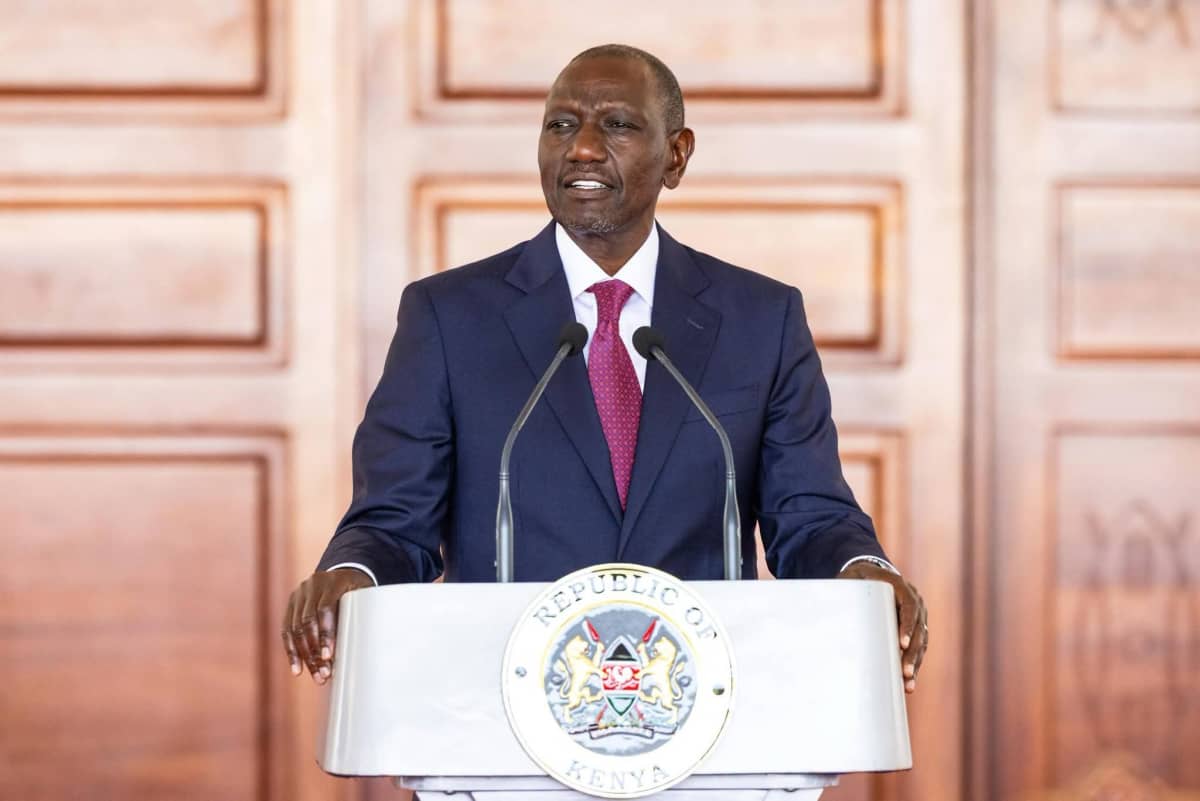
President William Ruto has directed the government to launch a crackdown on foreigners operating small-scale businesses in Kenya, with the exercise set to begin on Monday, September 7.
Speaking on Wednesday, September 2, Ruto announced that foreigners engaged in small-scale trading would be forced to shut down their businesses, arguing that such enterprises should be reserved for Kenyan citizens.
The President instructed the government to commence the crackdown next week, declaring, "From next week, all traders doing those small businesses should close them and if they don't..."

Ruto made the remarks while addressing Micro, Small, and Medium Enterprise (MSME) traders during a meeting at State House, where he argued that Kenya's improved business environment was intended to attract genuine investors rather than foreign hawkers.
“We have made efforts to improve the economy. We have not improved investor confidence for hawkers to come to Kenya,” Ruto told the traders.
The directive comes as the government pushes the Local Content Bill, 2025, alongside proposed amendments to the Public Procurement Act. The measures seek to strengthen local participation in the economy, increase opportunities for Kenyan workers and restrict foreign participation in selected sectors.
Ruto called for the expedited passage of the Local Content Bill, 2025, which is sponsored by Laikipia Woman Representative Jane Kagiri.
He directed National Assembly Majority Leader Kimani Ichung’wah and Trade Cabinet Secretary Lee Kinyanjui to work on further amendments to the proposed legislation as it moves through Parliament.
According to Ruto, the proposed law will establish a list of businesses that will be exclusively reserved for Kenyan citizens, effectively limiting foreign participation in certain areas of small-scale trade.
“We have a Bill in Parliament on Trade. In that Bill (Local Content Bill, 2025), we have proposed that there should be businesses that foreigners should not do here in Kenya, by law,” he stated.
The President specifically pointed to hawking and the operation of small retail outlets as businesses that should not be open to foreign nationals. “It cannot be that a person comes from China or elsewhere to be a hawker or open a small shop,” Ruto stated.
The Local Content Bill, 2025, seeks to require foreign companies operating in Kenya to ensure that Kenyan citizens make up at least 80 per cent of their workforce, including those occupying senior management and C-suite roles such as chief executive officers.
The proposed legislation would further require foreign firms to source at least 60 per cent of their goods and services from Kenyan suppliers.
For manufacturers involved in agriculture-related production, the bill proposes a stricter requirement, with companies expected to obtain 100 per cent of their agricultural raw materials and produce from local sources.
The 60 per cent local sourcing threshold would also extend to selected service sectors, including financial and insurance services, construction, transport, warehousing, logistics and security.
