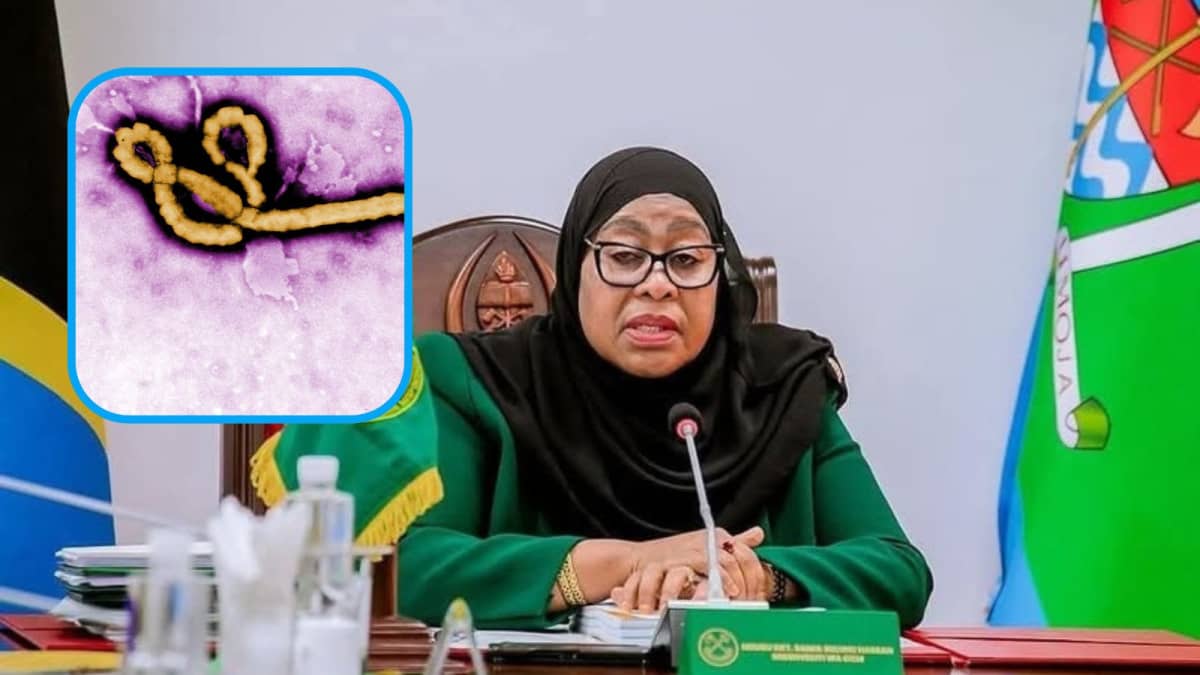
Tanzania has introduced mandatory health monitoring for travellers considered at high risk of Ebola infection, tightening screening measures at its borders following an outbreak in the Democratic Republic of Congo (DRC) and a rise in confirmed cases in Kenya.
Under the new measures, high-risk travellers will undergo daily health monitoring for 21 days, with authorities tracking their health status through automated messages and other communication channels.
The directive comes as Kenya's confirmed Ebola cases climbed to seven, including one death, after four new infections were reported on Saturday, October 17.
In an advisory, Tanzania said the measures were introduced in response to the outbreak in the DRC and a recent case in Kenya involving a patient who had travelled from the neighbouring country.

“Following the Ebola Virus Disease (EVD) outbreak in the Democratic Republic of Congo (DRC), and a recent case in Kenya of a patient travelling from the DRC, the Government of the United Republic of Tanzania (URT) has expanded its public health requirements related to international travel for incoming travellers in line with the International Health Regulations (2005) as amended in 2024, and the Tanzania Public Health Act of 2009,” the advisory stated in part.
The government added that high-risk travellers would be monitored daily for three weeks in line with its national entry and exit screening procedures.
“Mandatory follow-up through daily automated messages or other means of communication to monitor the health status of high-risk travelers for a period of 21 days, will be activated according to the National Entry and Exit Screening Standard Operating Procedures,” the advisory stated.
Tanzania Introduces New Travel Requirements
Under the updated requirements, travellers entering Tanzania must complete an online health declaration before departure or upon arrival.
Passengers are required to provide accurate information and retain a QR code or reference number for verification by health authorities.
The Ministry of Health will also screen travellers at airports, land borders and seaports, including temperature checks to identify individuals who may be exhibiting symptoms of an infection.
Anyone displaying signs of illness will be referred for further assessment in accordance with the country's national health procedures.
Travellers must also observe infection prevention measures, including proper handwashing and the use of sanitiser. Vehicles and other forms of transport suspected of contamination may be disinfected at entry points.
Meanwhile, reports indicated that Kenya-Tanzania border points at Namanga, Isebania and Lunga Lunga had intensified checks on Saturday evening, with officials examining the travel histories of people entering and leaving the two countries.
Kenya Intensifies Ebola Screening
Kenya has also stepped up screening at airports, land borders and other entry points as authorities seek to prevent further transmission of the virus.
Health officials have reportedly screened more than 665,000 travellers nationwide as the government monitors the outbreak. At Jomo Kenyatta International Airport (JKIA), passengers arriving from high-risk countries, including the DRC, Ethiopia and Uganda, are reportedly being directed through Gate 16 for screening.
Health officers use infrared thermometers to identify travellers with temperatures exceeding 38°C. Passengers are also required to complete online health declarations, present QR codes where applicable and provide travel histories covering the preceding 21 days.
The enhanced measures come amid growing international concern over the potential spread of Ebola beyond affected areas. Canada has advised its citizens travelling to Kenya to exercise a high degree of caution, while Malaysia issued a health advisory for its nationals living in or visiting the country by the end of September. Malaysia's advisory followed Kenya's first reported case of Bundibugyo virus disease on October 6, 2026.
Despite the rising number of infections, Kenya's Ministry of Health has urged the public to remain calm, exercise caution and rely on official updates as surveillance and response operations continue.
“Kenya remains open, with no restrictions on travel, trade or public gatherings. Remain calm, stay vigilant and follow official Ministry of Health updates,” Director General for Health Dr Patrick Amoth clarified.
How Ebola Spreads and When to Seek Medical Attention
Ebola spreads through direct contact with the blood or other body fluids of an infected person or someone who has died from the disease. It is not transmitted through the air.
People experiencing symptoms such as fever, unusual tiredness, muscle pain, vomiting or diarrhoea should seek immediate medical attention.
Anyone requiring guidance can also contact the Ministry of Health's toll-free line on 719.
