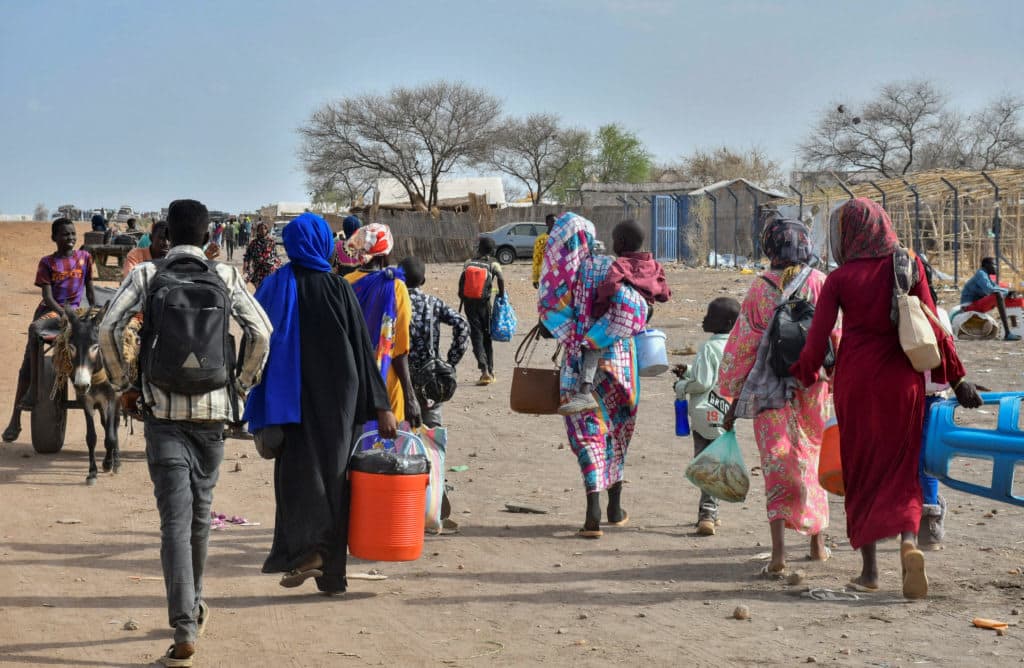
More than 5,000 people have been displaced from 10 villages in Sudan’s West Darfur region amid escalating violence, with the majority fleeing across the border into neighbouring Chad, according to a report by Citizen Digital on Wednesday, August 12.
The latest displacement underscores the worsening humanitarian crisis in Darfur, where civilians have endured deadly attacks, airstrikes and severe shortages of basic necessities since war erupted in Sudan in April 2023.
The International Organization for Migration (IOM) reported that its Displacement Tracking Matrix estimated on August 8 that 5,135 people had been forced from their homes in Sirba locality following clashes in the Bir Sleiba area.
The majority of those displaced reportedly crossed into Chad in search of safety. For civilians who remain in displacement camps, access to water has also become a major challenge.

“We stand in line by the hundreds from dawn beside a single, solar-powered well. Sometimes we wait for hours, only to return without water,” Nada al-Tijani, a displaced woman in Tawila camp in Darfur, said.
“My children constantly complain of stomach pain because we are sometimes forced to drink contaminated water from farms. Water here has become more expensive than bread…”
The latest displacement came days after a drone strike hit a traditional court in Ghara al-Zawaya village in North Darfur, killing at least 35 people, according to the Emergency Lawyers Group.
The group accused the Sudanese Armed Forces (SAF) of carrying out the attack, saying civilians had gathered at the court to resolve local disputes when the strike occurred.
The attack reportedly damaged the court, a civilian facility that serves both judicial and social functions.
Deadly Airstrikes
The escalating drone attacks add to a wider pattern of aerial bombardment documented during the conflict.
Human Rights Watch (HRW) reported that Sudanese forces carried out attacks using unguided bombs in densely populated residential and commercial areas of Nyala, South Darfur, in February 2025. The rights organisation described the attacks as indiscriminate, noting that the weapons used had wide-area effects and limited accuracy.
Jean-Baptiste Gallopin, a senior researcher at Human Rights Watch, observed: “The Sudanese army bombed densely populated residential and commercial neighborhoods in Nyala using imprecise bombs. These attacks killed dozens of men, women and children, destroyed families, and sowed fear and displacement.”
Human Rights Watch identified an OFAB-250 fragmentation bomb and a FAB multipurpose unguided bomb among weapons used in the attacks. It concluded that the February 3 strikes were presumed to be indiscriminate and violated international humanitarian law.
Intentionally or recklessly carrying out indiscriminate attacks can constitute a war crime.
Sudan’s Expanding Drone War
The conflict has increasingly featured drones, with the Sudanese army reported to have used Turkish-made Bayraktar TB2 unmanned aircraft, while Iranian-made Mohajer-6 drones have also reportedly been supplied to army bases.
A February 2026 New York Times investigation further reported that an Egyptian air base near Sudan and Libya was developed into a hub for advanced combat drones, believed to include Turkish-made Bayraktar Akıncı aircraft.
The investigation found that drones launched from the remote East Oweinat site had, over at least six months, carried out strikes against Rapid Support Forces positions inside Sudan in support of the Sudanese army.
The continuing violence has left millions displaced and deepened a humanitarian crisis in which civilians face not only the threat of bombardment but also increasingly severe shortages of water, food and shelter.
