Artificial intelligence safety company Anthropic has revealed in a report that it shut down a Kenya-based coordinated influence campaign that used its flagship AI model, Claude, to mass-produce pro-government content while targeting opposition leaders ahead of the 2027 General Election.
The operation, identified as GTG-54004, was uncovered in Anthropic's latest threat intelligence report examining sophisticated attempts to misuse its AI systems across areas including cyberattacks, surveillance, coordinated influence operations, biology and weapons development.
According to the company, the Kenyan campaign involved a single domestic actor who used Claude to generate large batches of political posts designed to appear like spontaneous public reactions rather than coordinated propaganda.
"We identified and removed an account that was used by a single actor to mass-produce Kenyan political content. The operation was built to look like spontaneous, grassroots public sentiment," Anthropic stated in the report obtained by Vantage Ke.
The actor reportedly used Claude during several sessions to generate batches of exactly 50 tweets at a time, explicitly instructing the AI model to make the content appear authentic and organically generated.
"The actor used Claude across several sessions to generate batches of exactly 50 tweets, explicitly instructing the model to make posts look like spontaneous grassroots commentary rather than a coordinated campaign," added the report.
Anthropic's Threat Intelligence team said the operator supplied the AI model with political topics, talking points and hashtags before directing Claude to humanise and format the content into deployment-ready posts for distribution across platforms.
In some instances, the posts were packaged into interactive copy-all widgets, allowing the material to be easily copied and disseminated.
Pro-Wandayi Messaging
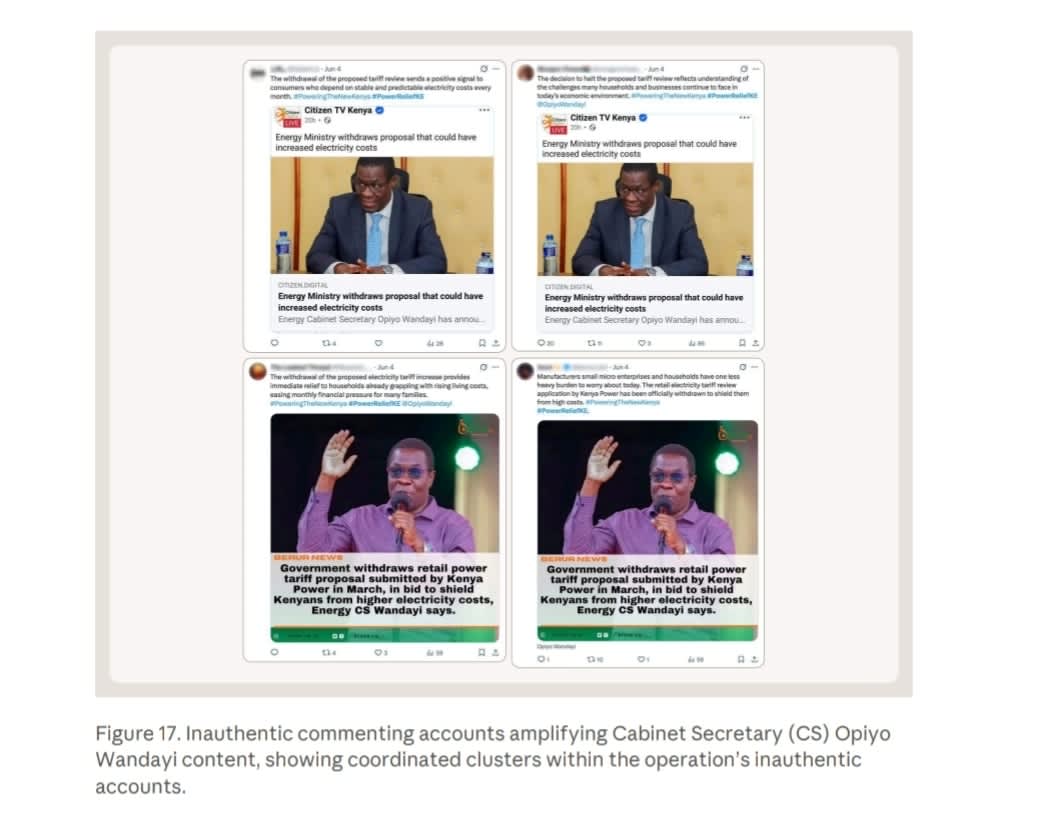
A major part of the campaign focused on Kenya's electricity tariffs and messaging surrounding Energy Cabinet Secretary Opiyo Wandayi.
According to Anthropic, a large number of AI-generated posts praised Wandayi over the halting of a scheduled Kenya Power electricity tariff increase, stating "The network focused its messaging on key Kenyan political issues and figures. A large portion of the AI-generated tweets praised Energy Cabinet Secretary Opiyo Wandayi for stopping a scheduled Kenya Power electricity tariff hike, using the hashtags #PowerReliefKE and #PoweringTheNewKenya to boost visibility."
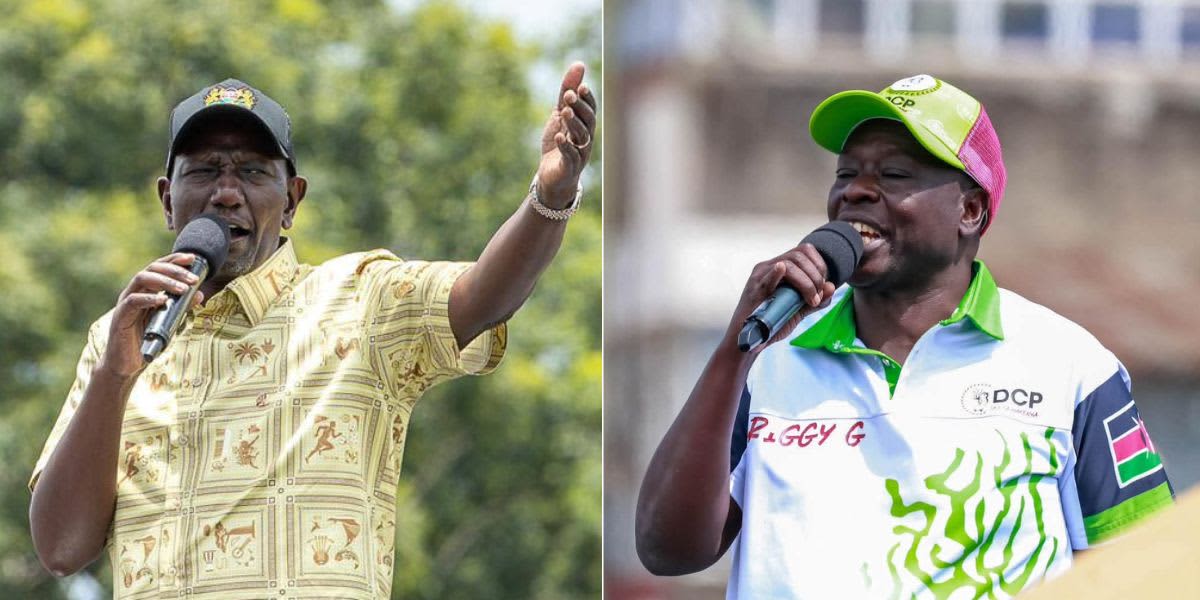
The operation simultaneously pushed narratives against the opposition, particularly claims suggesting that Kenya's United Opposition coalition was breaking apart before the 2027 General Election. The messaging directly targeted former Deputy President Rigathi Gachagua and former President Uhuru Kenyatta.
"Additionally, the network pushed stories claiming that Kenya's United Opposition coalition was breaking apart before the 2027 General Election, directly targeting politicians Rigathi Gachagua and former President Uhuru Kenyatta," Anthropic announced.
Anthropic described the activity as a structured political astroturfing operation, designed to create the appearance of widespread grassroots support for particular political narratives.
Investigators found that the campaign relied on a single playbook to amplify both pro-government and anti-opposition messaging, a pattern they said was consistent with a coordinated electoral communications effort.
However, despite the network's pro-administration tone, Anthropic said it found no evidence directly linking the Kenyan government to the operation.
"While we do not know the exact real-world identity of the people behind this operation, we believe this was a local Kenyan political astroturfing campaign. The network's pro-administration tone and specific hashtags suggest it was plausibly aligned with the ruling coalition, though we have not identified the exact organisation responsible," the report noted.
OpenAI Tip Led to Investigation
Anthropic said its investigation was launched after receiving a tip from OpenAI concerning repeat activity involving the operator. "Based on a tip shared by OpenAI about recidivist activity on their platform, we conducted an internal investigation into suspected coordinated inauthentic behaviour in Kenya and identified this operation. We removed the account and the organisation behind it, and built detections around its behavioural signature," the report continued.
The investigation also revealed that the same AI workflow had been used for commercial marketing campaigns involving Kenyan retail brands under the online personas "SHANKI" and "Elkins Marketer."
Promotional content was reportedly repackaged as seemingly organic social media posts, demonstrating how the same AI-driven system could be deployed for both political influence and commercial marketing.
Despite the campaign's structured nature, Anthropic concluded that its real-world influence was limited. Using the Breakout Scale, the company classified the operation as Category One, meaning the activity remained largely isolated within its own network of fake accounts and local influencers on a single platform.
The content ultimately failed to break into wider public conversations or influence genuine users.
Anthropic said lessons from the incident had since been incorporated into Claude's safety infrastructure to strengthen protections against future misuse, warning that generative AI was increasingly being exploited to manufacture artificial public consensus and make coordinated propaganda appear like genuine grassroots sentiment.