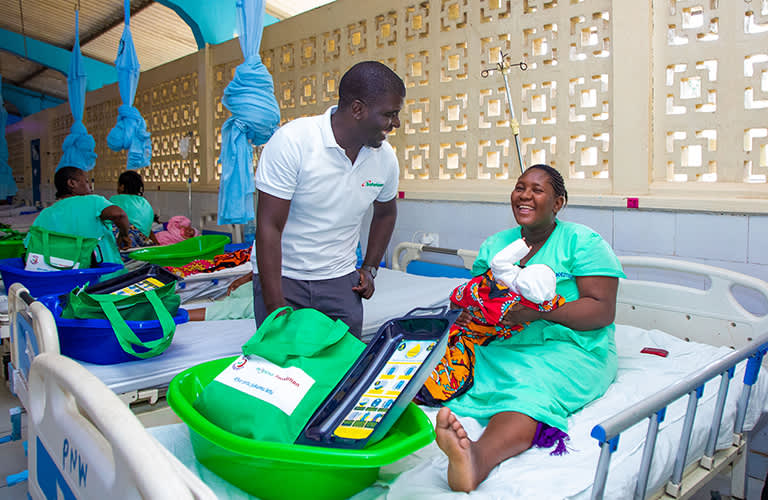
When Dorothy Kulola, a first-time mother in Changamwe, Mombasa county received the news that she was expecting her first baby, she had mixed feelings, elated that she was going to soon hold her first child but also wary of the uphill task it would be financially.
As the pregnancy progressed, Kulola was unsure of where to seek care considering her limited financial resources at the time.
One day, a community health promoter approached her and encouraged her to consider Port Reitz Level 4 Hospital. After hearing of the benefits, she immediately started pooling resources together.
While at the hospital, Kulola was pleasantly surprised to receive a Mama Pack, a post-delivery care package comprising of diapers and clothing for the baby, a shawl, soap, sanitary towels and a leso for the mother. The care pack also has a basin for bathing the baby and a bag.
“I always knew that having my first baby was going to be a huge responsibility, and the provision of these facilities is going to give me a head start as I plan to raise this baby,” said Kulola.
She was one of the 100 mothers to receive the Mama Packs at Port Reitz Level 4 hospital courtesy of the M-PESA Foundation. Through the initiative, the foundation aims to encourage safe deliveries in health facilities to reduce maternal mortality across the country. The kits are distributed to new mothers during bi-monthly medical camps organised by the foundation.
“We distribute Mama Packs to select health facilities whenever we hold medical camps as part of our maternal and child health initiatives,” says Sophie Onyango, Programme Manager, M-PESA Foundation.
Inyolater Akoth, who delivered twins at the same hospital is another beneficiary of the Mama Packs.
“I am grateful for this gift from the M-PESA Foundation. I was wondering where I would get diapers and clothing for my babies. This is a great day for me because I can now start planning how to take care of my babies,” said Akoth.
The M-PESA Foundation has a Reproductive, Maternal, Neonatal, Child and Adolescent Health (RMNCAH) Programme that seeks to address the three key delays that cause maternal and newborn deaths: the delay to seek care, the delay to receive care and the delay to reach care.
“There are various reasons why mothers do not seek care; culture is one, and the other is the cost of transport to hospitals. And even if they have the money, they do not have a hospital nearby. As a Foundation, we focus on ensuring that mothers get to the hospital and get the services they require,” says Onyango.
Mama Packs are a strategy to raise awareness among women and encourage them to deliver safely in health facilities.
“What we realised is that there are mothers who come to the hospital without the necessities that they need for their infants, like clothes or even basins to bathe their babies. Mama Packs support mothers so they can leave the hospital with dignity. This creates awareness that if one delivers in a health facility, they can leave with something,” adds Onyango.
Over the years, the Foundation has drawn key lessons from distributing Mama Packs. One such lesson is that it is critical to provide mothers with clean drinking water, which is why a water purifier is now included in the Mama Pack.
To achieve this, M-Pesa Foundation partnered with 4Life Solutions to include the SAWA water purifier.
“SAWA is a UV-based water purifier that harnesses the rays of the sun to make water safe for drinking. We want these mothers to take charge of their water while at home,” says Gladys Njoroge, a representative of 4Life Solutions.
The SAWA is a 6-litre-capacity product with an opening that one fills with water. The purifier is then placed under direct sunlight to allow ultraviolet (UV) rays to penetrate and expose it. The UV rays kill bacteria and protozoa in the water, making it safe to drink.
“The purifier has a UV indicator that serves two functions: one, to show if there is UV presence; if there is, it will start to blink, indicating that purification is in progress. You leave the SAWA in the sun until you see a smiley face; an indication that the water has been purified and is safe for drinking. The period it takes to purify the water depends on the intensity of the sun on a given day,” explains Njoroge.
Once the water is safe to drink, the SAWA can be suspended on a surface in the household, and a tap beneath the purifier dispenses the water. The product can last for 3 years.
“To clean the purifier after use, fill it up with water mixed with salt and place it out in the sun for 30 minutes. Salt is a natural antiseptic that kills any germs that could be contained in the SAWA,” Njoroge further explains.
According to Onyango, the M-PESA Foundation is open to partnerships that innovate and complement the items already in the Mama Packs.
The Mama Pack is playing a key role in encouraging mothers to seek care in hospitals, thereby reducing maternal mortality, while serving as the ideal starter pack for a new life for both mother and baby.