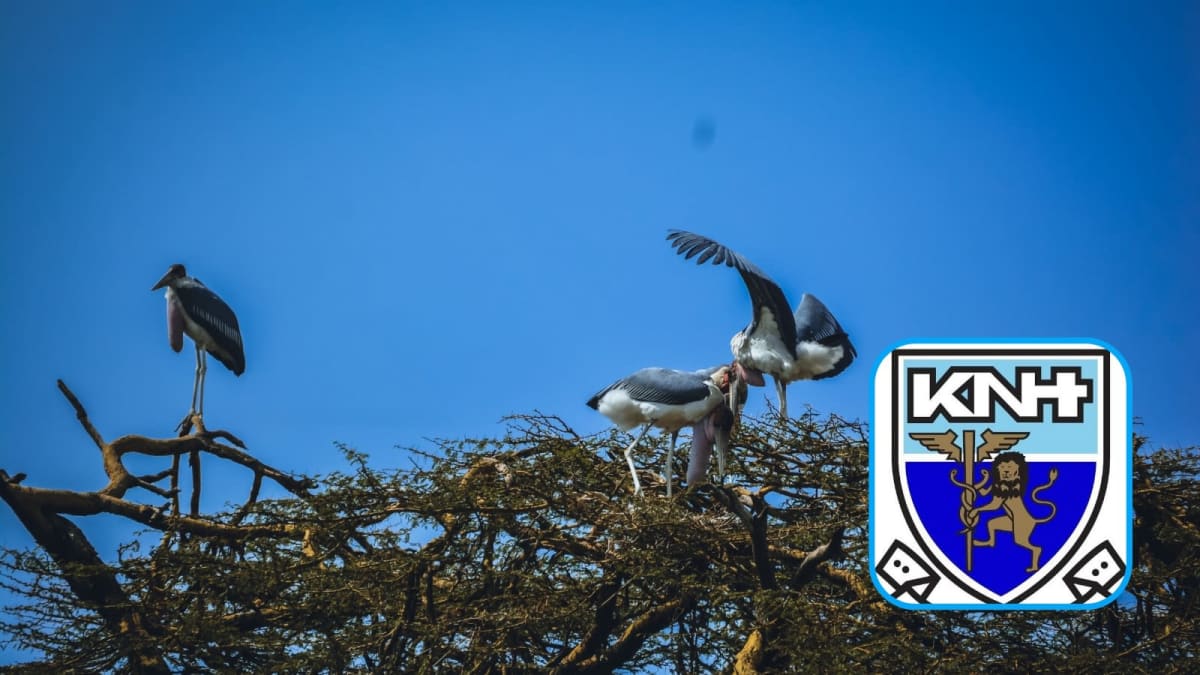
Kenyatta National Hospital (KNH) has defended its decision to cut down several mature acacia trees within its compound after a public uproar over the destruction of a long-standing nesting site for marabou storks.
The country's largest referral hospital said the African acacia trees, some more than 30 years old, had become old and decayed, posing a serious danger to patients, staff, visitors and hospital property.
According to KNH, the ageing trees had previously caused falling branches that damaged steam pipes, crushed parked vehicles and created safety hazards within the hospital.
The hospital also revealed that the deteriorating trees had previously led to the deaths of some of the birds nesting in them.

"The affected African acacia trees, which were over 30 years old, had become aged and decayed, resulting in the frequent falling of branches and posing a significant safety risk," KNH stated.
Hospital management said the trees were removed after a technical assessment and ahead of the rainy season as a preventive safety measure.
"The exercise was intended to protect not only patients, staff, visitors and hospital property, but also the marabou storks from the dangers posed by the deteriorating trees," the statement added.
The explanation comes after images circulated online showing injured and displaced marabou storks following the felling of the trees where they had nested for decades.
The incident triggered widespread criticism, with many Kenyans questioning whether environmental impact assessments had been conducted before the trees were cut down.
"They cut down the acacia trees this week at Kenyatta National Hospital. The marabou storks that had nested there for decades didn't have anywhere to go. Some died. Some got injured. All because nobody thought to check what was living in those branches first," one netizen stated.
Marabou Storks' Importance To Nairobi
Environmental experts say marabou storks play an important ecological role in Nairobi by acting as natural scavengers that help dispose of organic waste and animal carcasses across the city.
Despite their environmental benefits, the birds have frequently been at the centre of conflicts with city authorities due to the noise they produce and the droppings they leave behind, leading to repeated pruning and removal of trees in urban areas.
The storks have lived in various parts of Nairobi for decades, commonly nesting in tall acacia trees within busy urban spaces. However, they have gradually been displaced from several traditional nesting sites, including around Nyayo National Stadium and along the Mombasa Road corridor during the construction of the Nairobi Expressway.
They have also disappeared from parts of Nairobi's Central Business District, including sections of Kenyatta Avenue and areas surrounding the Kenyatta International Convention Centre (KICC).
In response to the latest controversy, KNH said it is working with relevant government agencies to safeguard the affected birds, including facilitating their safe relocation where necessary.
The hospital also pledged to restore the lost tree cover. "KNH regrets the disruption to the birds' habitat and will undertake a tree replacement programme by planting suitable tree species in appropriate locations across the hospital grounds as part of its commitment to environmental conservation and public safety," the hospital said.