
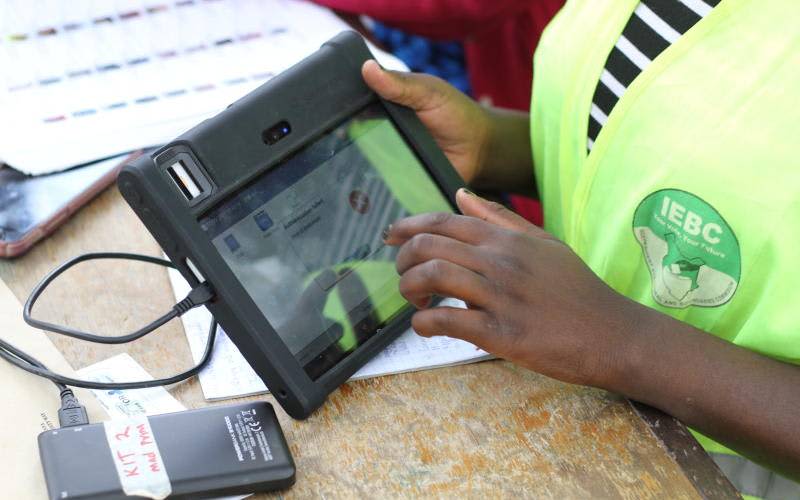
Democracy for Citizens Party (DCP) leader Rigathi Gachagua has renewed his criticism of the Independent Electoral and Boundaries Commission (IEBC), alleging that senior officials within the electoral body are attempting to favour a South Korean company in the procurement of technology for the 2027 General Election.
In a statement seen by Vantage Ke on Tuesday, September 1, Gachagua claimed that IEBC Chairperson Erastus Ethekon and Vice Chairperson Fahima Abdallah were behind efforts to award the tender to the unnamed South Korean firm.
According to the former Deputy President, requirements contained in the procurement documents were allegedly designed to suit the company before the tender was made available to potential bidders.
“The Chairman of IEBC and his Vice Chair are determined to force the discredited South Korean firm into the 2027 General Elections for financial gain and to bungle the elections,” Gachagua stated.
Gachagua further alleged that the alleged procurement plan faced internal resistance after officials involved in the commission’s supply chain and electoral management processes declined to support specifications they considered problematic.
He claimed that some IEBC officials were pressured to defend the tender specifications before the Public Procurement Administrative Review Board (PPARB), but refused to provide what he described as false evidence intended to conceal an improper procurement process. According to Gachagua, the officials subsequently faced disciplinary or administrative consequences.
He alleged that nearly the entire team was transferred to counties far from their previous stations and replaced by individuals he described as loyal to the commission’s leadership.
Gachagua linked the alleged transfers to staff changes contained in an IEBC letter dated August 12, arguing that the changes were evidence of retaliation against officials who had refused to cooperate with the purported scheme.
The DCP leader also questioned the timing of any potential replacement of the Integrated Election Management System (IEMS), warning that introducing a new system less than a year before the election could create operational and security challenges.
He expressed particular concern over the potential impact of changes to election technology on the voters’ register. Gachagua alleged that a system transition could create opportunities for interference with voter registration data, particularly in constituencies and regions where political support for President William Ruto is declining.
“It is my considered opinion, following advice from procurement experts and IEBC insiders, that it is not technically possible to procure a new election management system given that the elections are 11 months away, and there is practically no time to facilitate digital migration from the current system and address whatever inadequacies are anticipated,” Gachagua added.
The allegations come as political parties and other stakeholders increasingly turn their attention to preparations for the 2027 General Election, with the credibility and independence of the electoral process expected to remain a major political issue.
Gachagua, who is currently in the United States, said the developments surrounding the procurement process had become serious enough to interrupt his planned break.
He claimed that officials within the electoral commission had approached him because they wanted Kenyans to understand what was allegedly taking place within the institution.
The latest accusations also come shortly after Deputy President Kithure Kindiki warned opposition figures against what he described as intimidation or interference with the IEBC.
However, the electoral commission has rejected Gachagua’s allegations that the election technology tender had already been awarded to a South Korean company. IEBC maintained that procurement of the IEMS remains in its preliminary stages and that no preferred supplier has been selected.
The commission further stated that the procurement process is currently suspended pending the determination of issues before the Public Procurement Administrative Review Board.
The contrasting positions have placed the procurement of election technology at the centre of renewed political debate ahead of the 2027 polls, with Gachagua calling for scrutiny of the process while the IEBC insists that no supplier has been selected.
