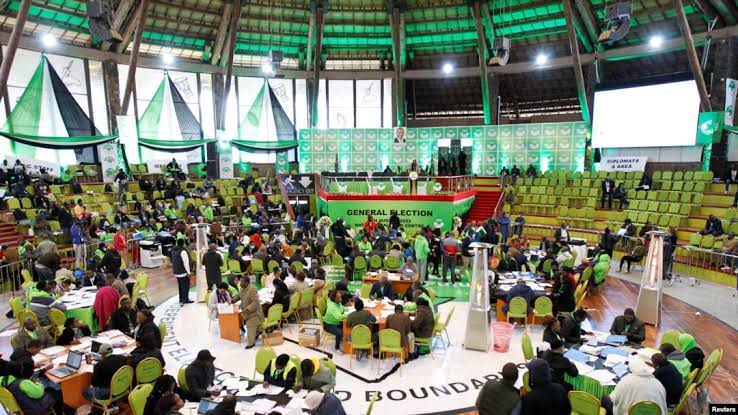
The High Court has rejected a constitutional petition challenging the national verification of presidential election results, affirming that the final declaration made at the national tallying centre remains legally binding.
In a ruling delivered on Tuesday, September 22, the court upheld the Independent Electoral and Boundaries Commission’s (IEBC) authority to verify constituency results forms before declaring the winner of a presidential election.
Busia Senator Okiya Omtatah had challenged the national-level re-tallying process, arguing that it amounts to an unlawful second verification stage that compromises transparency.
The judges also ruled that in cases where electronic results conflict with physical election documents, the figures recorded at the polling station level must take precedence.

Omtatah had argued that electoral law grants the IEBC powers that were not contemplated by the Constitution by allowing it to operate a central 'clearing house' at Bomas where presidential results are subjected to further verification.
The Senator cautioned that introducing additional verification stages at the national level could create opportunities for human interference while also causing delays in the declaration of results.
He had asked the court to find that the IEBC Chairperson should simply aggregate the final results transmitted from the 290 constituencies.
The case had been filed amid increased debate over Kenya’s electoral framework, with former Chief Justice David Maraga calling for the scrapping of the central tallying facility at Bomas of Kenya.
In a statement released last week, Maraga maintained that the Constitution does not expressly establish a central tallying facility and argued that presidential results should be tallied and finalised at the constituency level.
The High Court, however, found that national-level verification serves as an important safeguard for confirming the accuracy of results before a presidential winner is officially declared.
Separately, civil society leaders under the People’s Coalition on Electoral Reforms have called for independent constituency servers to facilitate real-time public access to election results.
The court is also handling another major petition concerning the next election, with Justice Gregory Mutai set to issue a ruling on February 25, 2027, in a case seeking to suspend the elections until fresh constituency and ward boundaries are established.
Through his lawyer, the petitioner argued that the most recent boundary review was undertaken in 2012, making a new review constitutionally due by March 2024.
He further claimed that despite the IEBC becoming fully constituted in July 2025, the commission failed to undertake its mandatory boundary review and instead proceeded with preparations for the elections.
The petitioner warned that holding elections using outdated boundaries would undermine fair representation by failing to reflect major changes in population distribution, urbanisation and economic development across the constituencies.
