
The High Court has upheld the impeachment of Rigathi Gachagua as Deputy President in October 2024.
On Monday, June 8, the High Court affirmed the Senate’s decision to impeach Gachagua, throwing out a series of consolidated petitions that had sought to overturn his removal from office.
In a landmark judgment, a three-judge bench comprising Eric Ogolla, Anthony Murima and Fridah Mugambi ruled that Parliament acted within the confines of the law during the impeachment process and that the proceedings satisfied constitutional requirements on public participation.
The judges rejected claims that Parliament lacked the authority to handle the impeachment due to the incomplete implementation of the two-thirds gender rule, terming the arguments without merit.
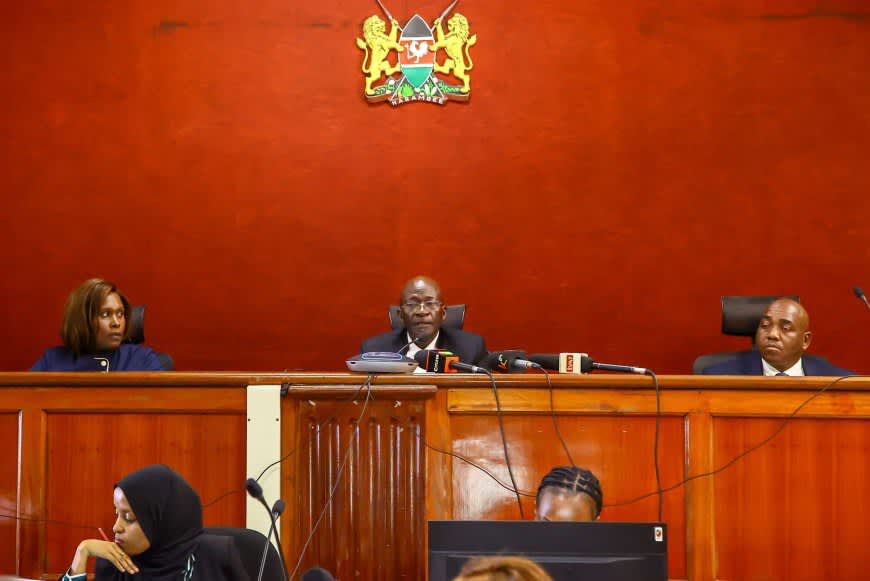
According to the court, the issue did not strip Parliament of its constitutional powers to deliberate on and determine impeachment proceedings against Gachagua.
The bench also upheld the Parliamentary Standing Orders used during the process, finding that both the National Assembly and the Senate followed lawful procedures throughout the impeachment.
On the issue of public participation, the court found that the National Assembly conducted the exercise in accordance with constitutional provisions.
The judges further dismissed allegations that the Speakers of the National Assembly and Senate, as well as MPs and Senators, were biased during the proceedings, noting that the petitioners failed to provide sufficient evidence to support the claims.
“The mere fact that legislators belong to particular political parties, hold political views or have publicly expressed opinions on an impeachment matter does not, by itself, constitute constitutional bias or invalidate impeachment proceedings,” Justice Ogolla stated.
Regarding the succession of office, the court also validated the appointment of Deputy President Kithure Kindiki, dismissing claims that the lack of commissioners at the Independent Electoral and Boundaries Commission (IEBC) rendered the process unconstitutional.
At the same time, the judges held that Gachagua was not accorded a fair hearing during his Senate impeachment trial, pointing to procedural shortcomings that compromised his ability to effectively defend himself.
The court found that denying Gachagua adequate time and opportunity to present his defence amounted to a violation of his right to a fair trial, although the breach was not sufficient to overturn the impeachment.
Consequently, the judges awarded Gachagua Ksh50 million in compensation, with the Senate ordered to pay the damages.
“The prayer seeking to quash the resolution of the Senate to impeach Gachagua is hereby declined. A declaratory order is hereby issued that Gachagua's fair trial rights were infringed when the Senate declined to allow an adjournment in the impeachment proceeding despite his absence,” Justice Eric Ogolla stated.
Despite finding that his rights had been violated, the court upheld the impeachment process, meaning Gachagua's removal from office remains valid and in effect.
