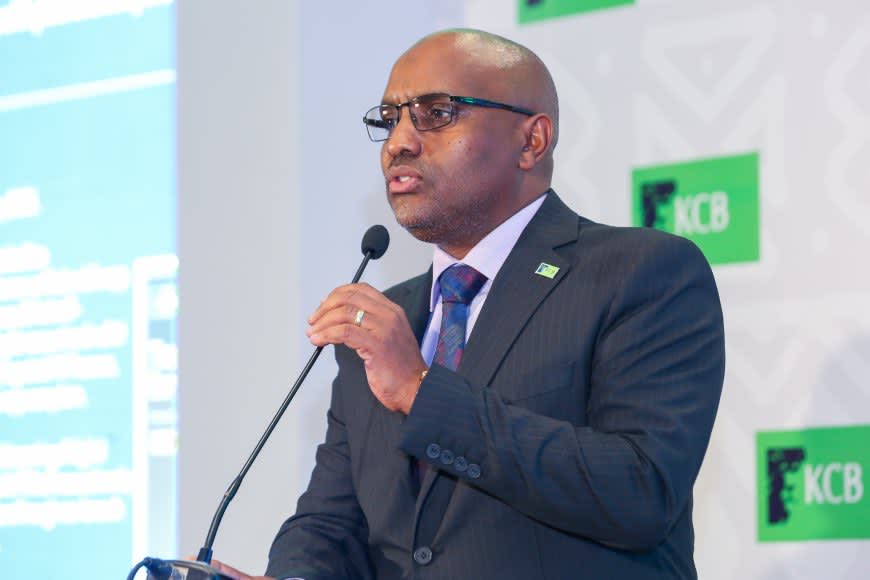
KCB Group has posted a sharp rise in first-quarter profits, cementing its position as one of East Africa’s most resilient banks despite mounting economic pressure across the region.
The banking giant announced a pre-tax profit of KSh24.4 billion for the quarter ending March 31, 2026 — a 15.3 per cent increase from the KSh21.2 billion recorded during the same period last year.
The strong performance came at a time when businesses and households across the region continue to grapple with high borrowing costs, weaker consumer spending and uncertainty linked to global conflicts.
KCB said total operating income rose by 8.5 per cent to KSh53.6 billion, largely driven by growth in interest-earning assets and expansion across regional markets. The Group’s balance sheet also crossed the KSh2.3 trillion mark after expanding by 10.8 per cent, supported by a surge in customer deposits.
Customer deposits jumped 16 per cent to KSh1.7 trillion, while the lender’s gross loan book expanded to KSh1.32 trillion from KSh1.21 trillion a year earlier.
The lender also reported improved asset quality, with its non-performing loan (NPL) ratio dropping significantly from 19.3 per cent to 16.6 per cent. The stock of bad loans fell to KSh217.8 billion from KSh233.3 billion, signaling aggressive recovery efforts by the bank amid a difficult credit environment.
KCB Group CEO Paul Russo said the lender’s performance reflected disciplined execution and heavy investment in digital banking despite persistent economic headwinds.
“Despite the challenging operating environment, we delivered solid growth driven by disciplined execution, continued investment in digital innovation, and our unwavering commitment to providing financing which catalyzes economic transformation across the region,” Russo said.
“We continued to optimize our regional footprint and scale to best serve our customers and create sustainable shareholder value.”
However, Russo warned that the ongoing conflict in the Middle East continued to pose risks to regional economies.
“While economic activity in East Africa remained resilient, we continued to see the impact of the Middle East conflict on economies, with a likely ripple effect of depressed credit demand, increased credit risk and lower remittance receipts, and on deposits,” he added.
KCB’s non-funded income — which includes fees, commissions and forex trading — grew by 8.3 per cent to KSh17 billion, boosted by increased digital loan uptake and foreign exchange transactions.
At the same time, operating costs rose 7.3 per cent to KSh24.3 billion due to higher staff costs, technology investments and expansion expenses.
The lender maintained strong capital buffers, with its core capital ratio standing at 18.2 per cent against the regulatory minimum of 10.5 per cent. Its liquidity ratio closed at 51.1 per cent.
KCB said subsidiaries outside Kenya continued playing a bigger role in earnings, contributing nearly 30 per cent of the Group’s profit before tax. Non-banking subsidiaries including KCB Bancassurance, KCB Investment Bank and KCB Asset Management also remained profitable.
Group Chairman Joseph Kinyua said the lender remained confident about navigating future economic shocks despite global uncertainty.
“The Group’s strong start to the year is a clear affirmation of the effectiveness of our long-term strategy, the resilience of our regional businesses, and the discipline with which we continue to execute our priorities,” Kinyua said.
“The Middle East conflict presents a significant counterforce to global growth through its impact on commodity markets, inflation expectations and financial conditions.”
Beyond banking, KCB continued expanding its footprint through high-profile partnerships and sponsorships during the quarter.
The bank partnered with UNHCR to support refugee financial inclusion programmes, secured KSh12.5 billion in green financing for MSMEs and farmers, and injected KSh227 million into the 2026 WRC Safari Rally sponsorship.
KCB also rolled out cheaper Pesalink charges, introducing a flat KSh20 fee while making transfers below KSh1,000 free as competition for digital payments intensifies among Kenyan banks and fintech firms.