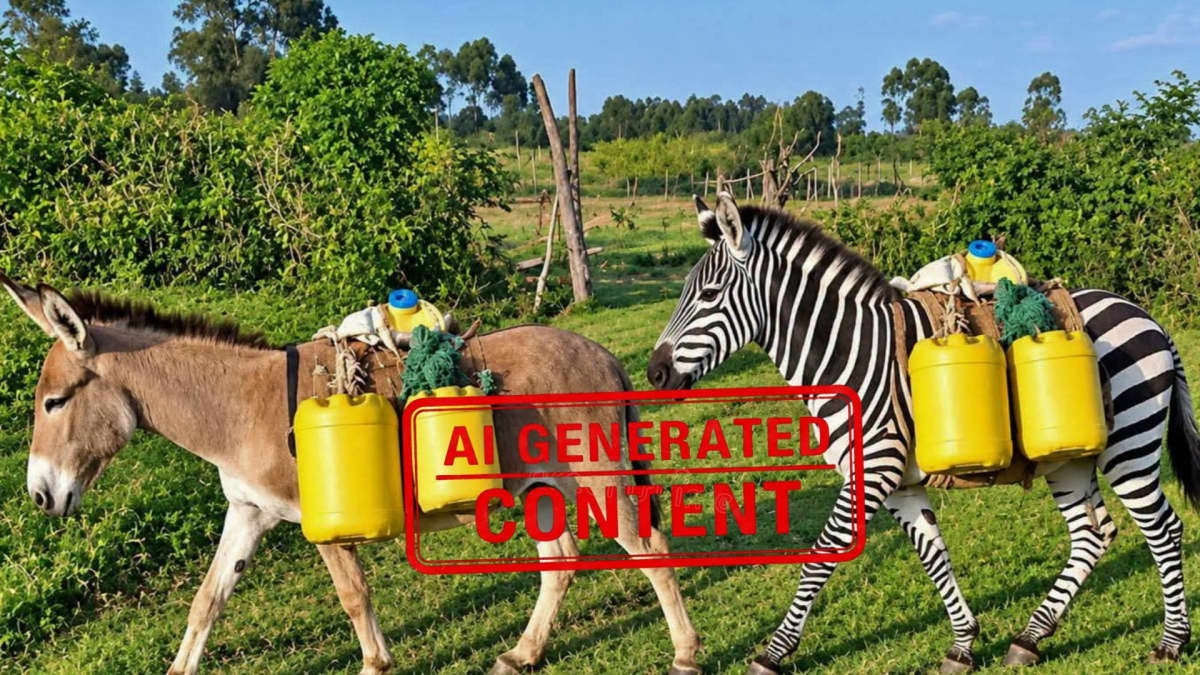
The Kenya Wildlife Service (KWS) has dismissed a viral image purportedly showing a zebra carrying water alongside donkeys, confirming that the widely shared photograph was generated using artificial intelligence (AI).
The image, which circulated on social media, appeared to show a zebra performing work commonly associated with domesticated animals. Its realistic appearance prompted reactions online, with some users questioning whether wild animals could be trained or kept for domestic purposes.
KWS, however, moved to clarify that the image was not an authentic photograph and used the incident to remind the public that wild animals should not be captured, tamed, or subjected to domestic activities.
In a public notice, the wildlife agency cautioned Kenyans against treating wild animals like livestock or other domesticated animals, emphasising that their wild nature must be respected. “Wild means wild. Zebras and other wildlife must never be captured, tamed or used for domestication,” KWS stated.
The agency further urged communities and private landowners who live alongside wildlife to embrace conservation measures instead of attempting to control, tame or domesticate animals that stray onto their property.
KWS noted that landowners with wildlife on their farms or other private and community-owned land can contribute to conservation by establishing conservancies. Such initiatives can provide a structured framework for managing wildlife while protecting habitats and supporting coexistence between communities and animals.
"Landowners and communities with wildlife on their land can instead help protect them by establishing private or community conservancies registered by KWS," it added.
The warning also comes at a time when AI-generated images and videos are becoming increasingly sophisticated and capable of producing highly realistic scenes. Such content can easily be mistaken for genuine photographs, particularly when shared without information about its origin.
The zebra image therefore offered another reminder to social media users to verify unusual wildlife claims before accepting or sharing them as factual.
KWS also cautioned members of the public against keeping wild animals or using them to perform domestic work, noting that such practices could pose risks to both people and wildlife.
Rather than attempting to capture or handle wildlife independently, the agency encouraged Kenyans who encounter animals on their farms or other areas where they do not normally belong to seek professional assistance. "In case you encounter wildlife on your land and need guidance, call our toll-free number on 0800 597 000," the agency stated.
The hotline provides landowners and communities with a direct avenue to seek guidance when dealing with wildlife encounters. This is particularly important in areas where human settlements and agricultural land border wildlife habitats, increasing the likelihood of animals moving into farms, residential areas, or other developed spaces.
Human-wildlife interactions have remained a recurring concern in parts of Kenya, particularly around areas bordering national parks and other wildlife habitats. Encounters can involve relatively less threatening species as well as predators capable of posing serious risks to people and livestock.
In January 2026, KWS issued an alert after two lionesses were reported in commercial and residential areas around Sholinke and Mlolongo, locations situated outside Nairobi National Park.
The reports highlighted the challenges associated with human-wildlife coexistence in areas where urban development and wildlife habitats are increasingly close to one another.
Residents in parts of Rongai and Lang'ata have also previously raised concerns about wildlife moving beyond the Nairobi National Park boundary, including reports of animals crossing into populated areas at night.
