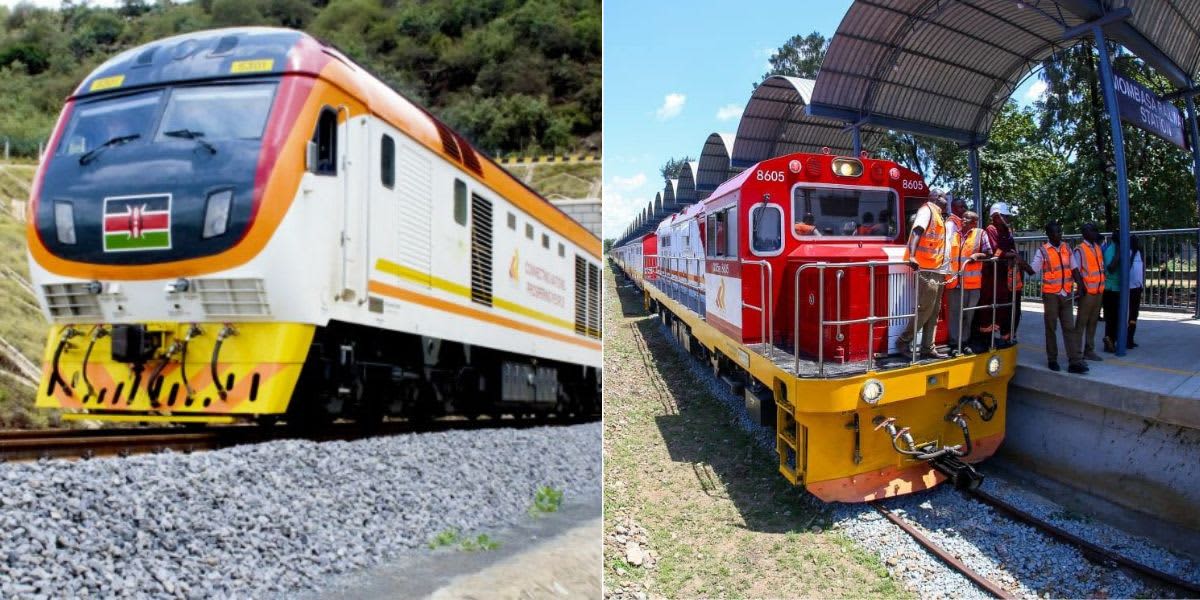
Kenya’s railway network consists of two distinct systems — the older Meter Gauge Railway (MGR) and the newer Standard Gauge Railway (SGR). Although both are operated under Kenya Railways, they differ significantly in track width, history, coverage, and the role they play in the country’s transport network.
The most basic difference is the width of the tracks. MGR uses tracks measuring one metre across, commonly referred to as metre gauge. SGR, meanwhile, uses the international standard gauge of 1.435 metres.
The difference may appear small, but it has major implications for railway operations. Trains designed for one track gauge cannot simply move onto a railway built to another gauge because their wheels and axles are configured differently.
Moving between the two systems therefore requires specialised infrastructure or equipment rather than a straightforward transfer from one line to another.
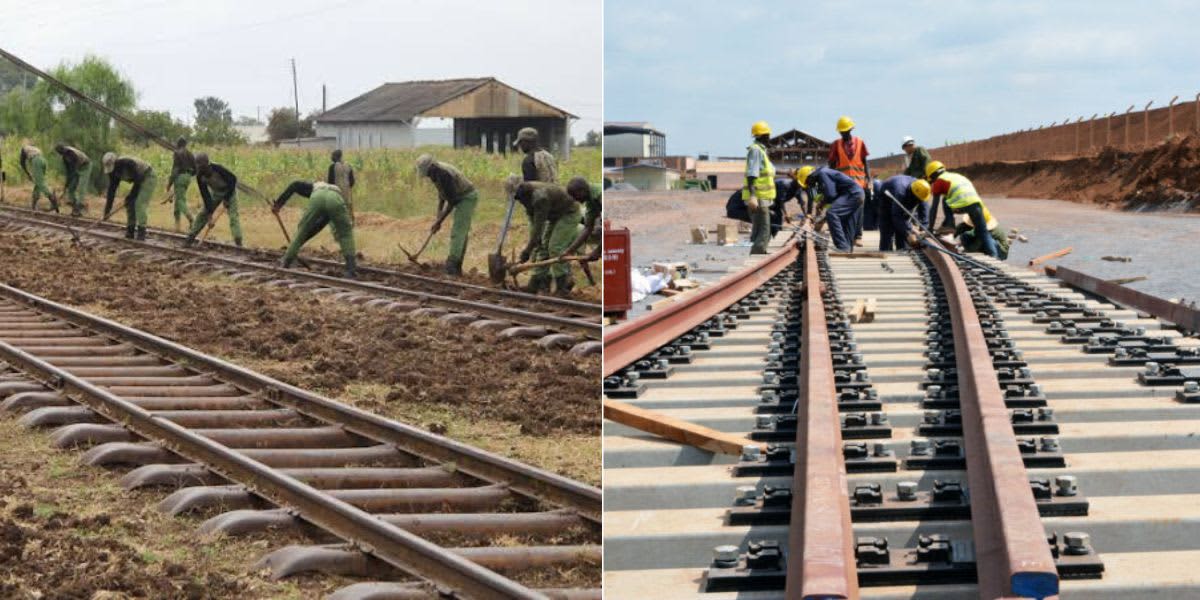
What is the Meter Gauge Railway?
The Meter Gauge Railway is Kenya’s older railway network and traces its origins to the Kenya-Uganda Railway, whose construction began in 1896 and was completed in the early 1900s.
The network formed the backbone of Kenya’s railway transport for generations, linking major urban centres, agricultural regions and trading areas. Much of the MGR infrastructure predates the SGR by more than a century.
According to Kenya Railways in an explainer on Saturday, September 5, the MGR network in Kenya extends for about 2,046 kilometres, making it substantially longer than the SGR in terms of total network coverage. Its lines connect several parts of the country, including Nyahururu, Kisumu, Nanyuki and Malaba.
The network has also undergone rehabilitation on selected routes. One example is the Nanyuki MGR line, which has recently undergone rehabilitation. The wider railway network includes a route stretching from Shimanzi in Mombasa, covering hundreds of kilometres through the country.
The Kisumu MGR line has also been restored, reconnecting central and western Kenya with the Port of Kisumu. The restoration is intended to strengthen rail connectivity and facilitate movement of goods linked to trade around Lake Victoria.
MGR services are therefore not simply a remnant of Kenya’s railway history. Parts of the network continue to support passenger and freight transport, while other sections are being rehabilitated or developed to serve commuter and regional transport needs.
In Nairobi, for example, the Riruta-Ngong commuter railway line is under construction. The 12.5-kilometre route is intended to provide an alternative transport option for commuters travelling along the busy Ngong Road corridor.
What is the Standard Gauge Railway?
The SGR is Kenya’s newer railway system and was designed with higher-speed passenger and freight operations in mind.
The main Mombasa-Nairobi SGR route covers about 592 kilometres. It significantly reduced the time required to travel between the two cities by rail, with passenger journeys taking roughly five hours.
Unlike the MGR, which developed over more than a century through successive routes and rehabilitation programmes, the SGR was constructed as a modern railway system with dedicated infrastructure for passenger and cargo operations.
The SGR network has also been extended beyond Nairobi. A 120-kilometre extension serves the Nairobi-Suswa-Naivasha corridor and includes infrastructure for handling cargo. This expansion has given the SGR a role beyond intercity passenger transport, particularly in moving freight between the Port of Mombasa and inland destinations.
Why does Kenya have both systems?
The existence of two railway gauges is not unique to Kenya. Countries around the world operate railway networks with different track gauges, often because individual lines were constructed during different historical periods or for different engineering and economic reasons.
India, for example, has historically operated broad gauge, metre gauge and several narrow gauges. Its Project Unigauge programme has sought to convert many metre- and narrow-gauge routes to broad gauge.
Australia also operates three major gauges: standard gauge at 1.435 metres, broad gauge at 1.600 metres and narrow gauge at 1.067 metres.
Spain combines its 1.668-metre Iberian gauge network with standard-gauge lines used for high-speed rail. South Africa predominantly uses the 1.067-metre Cape Gauge, while Japan uses 1.067-metre gauge for most conventional railways and standard gauge for its Shinkansen high-speed network.
Kenya’s railway system therefore reflects both historical legacy and modern transport planning.
The MGR remains important because of its extensive network and established links to towns and regions across the country. The SGR, meanwhile, represents Kenya’s investment in newer railway infrastructure designed to support faster passenger services and large-scale freight movement.
The two systems consequently serve complementary roles rather than being interchangeable versions of the same railway. The key distinction starts with the track: MGR is one metre wide, while SGR is 1.435 metres wide. That technical difference helps explain why trains built for one network cannot simply switch to the other without specialised arrangements.
