
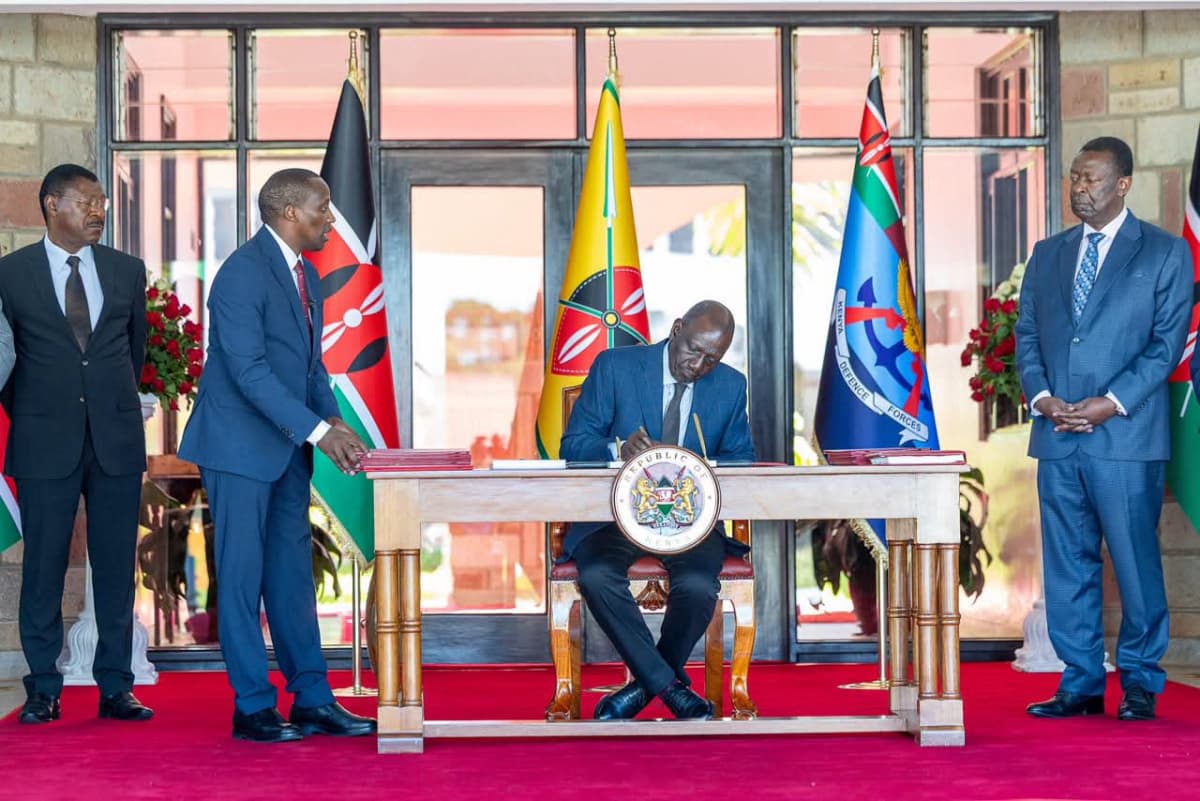
President William Ruto has signed a new law allowing the Kenya Revenue Authority (KRA) to receive additional funding whenever it collects more taxes than the government had projected.
The Kenya Revenue Authority (Amendment) Act, 2026, provides for the tax agency to receive 3% of the revenue collected above its target in each quarter of the financial year.
Under the arrangement, KRA will earn additional funds if its tax collections surpass the revenue estimates set by the government, introducing a financial incentive for exceeding quarterly targets.
According to the assent brief, the measure is designed to enhance the authority's efficiency and improve its revenue collection performance.
The additional allocation could help finance employee bonuses if the funds are designated for staff rewards. However, the legislation does not guarantee automatic bonuses for all KRA employees or specify the amount individual workers may receive.
Beyond the performance-based incentive, the new law also establishes a minimum annual funding allocation for KRA to support its operations.
The authority will receive at least 2% of the revenue it is expected to collect during each financial year, providing a guaranteed funding baseline.
“The Bill now provides that the funds of the Authority shall include an amount not less than two per cent (2%) of the revenue estimated in the financial estimates for each financial year to be collected by the Authority,” the brief reads in part.
The legislation also outlines the additional allocation tied to revenue collected beyond quarterly projections.
“Similarly, the Bill provides an incentive measure that three per cent (3%) of the revenue actually collected in any quarter of the financial year in excess of the amount estimated to be collected,” the new law signed on October 16 at Eldoret State Lodge adds.
The changes come as the government seeks to strengthen domestic revenue collection to finance public expenditure while limiting its dependence on borrowing.
Higher tax collections could provide the Treasury with additional resources to fund public services and meet budgetary obligations without necessarily introducing new taxes.
KRA is responsible for collecting government revenue through various taxes and duties, including income tax, Value Added Tax (VAT), excise duty and customs duties imposed on imported goods.
The authority has been under pressure to meet increasingly ambitious revenue targets as the government pursues greater reliance on locally generated revenue to finance its budget.
The new incentive framework is expected to encourage improved performance by linking additional institutional funding to revenue collected beyond the government's quarterly estimates.
Changes to KRA Board
The Kenya Revenue Authority (Amendment) Act, 2026, also introduces changes to the composition of the authority's board.
Among the changes is the removal of provisions relating to ex officio membership, alongside the inclusion of the Managing Director of the Kenya Ports Authority (KPA) in the board's composition.
The inclusion of the KPA chief is intended to strengthen coordination between the two government agencies, whose responsibilities intersect in the collection of taxes on imported goods.
KRA oversees the assessment and collection of customs duties and other applicable taxes, while KPA manages port operations that facilitate the movement of imported and exported cargo.
Closer cooperation between the institutions could improve information sharing and coordination in customs administration, supporting efforts to enhance revenue collection.
The amendments therefore combine a performance-based funding incentive with changes to KRA's governance structure, as the government seeks to improve the efficiency of tax administration and strengthen domestic revenue mobilisation.
