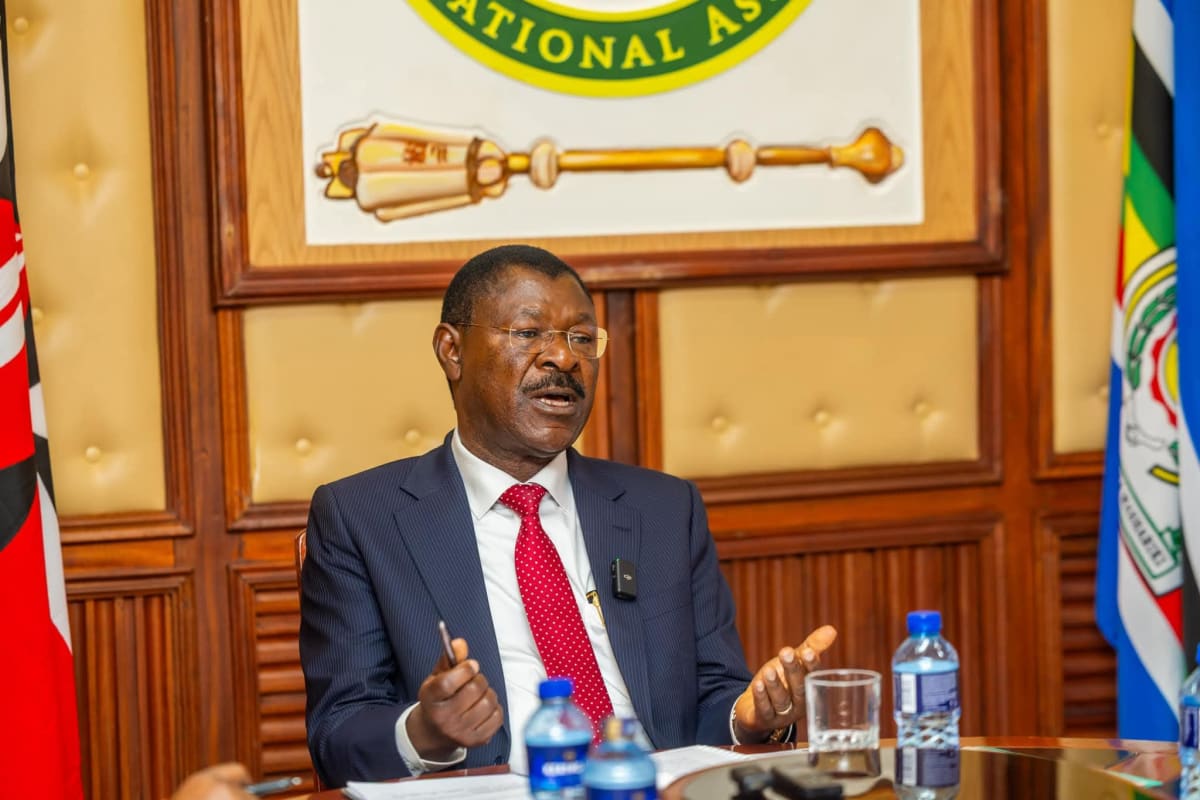
National Assembly Speaker Moses Wetang'ula has challenged the National Cohesion and Integration Commission (NCIC) to rebuild public confidence ahead of the 2027 General Election, warning that the agency has developed a reputation for only becoming active during election periods.
Speaking at Parliament Buildings during a meeting with the commission led by Chairperson Bishop Kepha Omae on Wednesday, August 5, Wetang'ula urged NCIC to take a more proactive role in combating hate speech, political incitement and ethnic divisions throughout the electoral cycle.
According to the Speaker, the commission must regain the trust of Kenyans if it is to effectively deliver on its constitutional mandate of promoting national unity.

"NCIC suffers from serious trust issues. The Commission was formed from the ashes of the 2007 post-election violence to bridge divisions created by political differences. It should not be active only during elections," Wetang'ula called out.
Wetang'ula argued that lasting national cohesion would only be achieved through continuous civic education aimed at changing attitudes, adding that ethnic identity itself was not the problem but how politicians exploit it to divide communities.
He further called on the commission to work closely with the Ministry of Education to instil values of unity among learners, saying the next generation would play a crucial role in shaping a more cohesive country.
The Speaker also urged NCIC to strengthen collaboration with the Directorate of Criminal Investigations (DCI), the Office of the Director of Public Prosecutions (ODPP), the Judiciary and the Independent Electoral and Boundaries Commission (IEBC) to improve enforcement against offenders.
"You have the power to investigate, but prosecution rests with the Director of Public Prosecutions. NCIC needs to carve out its niche, clean its own house and earn the respect of Kenyans. Parliament will support the Commission within the law," he added.
With political activity expected to intensify ahead of the 2027 polls, Wetang'ula maintained that elections are a continuous process rather than a single voting day event, warning that hate speech and inflammatory rhetoric must be addressed long before Kenyans head to the ballot.
"Elections are not just about casting a vote; they are a process, and NCIC has a critical role in helping police communities against hate speech and leaders who sow disharmony," he continued.
In response, Bishop Omae revealed that the commission had already rolled out a roadmap for the 2027 elections centred on prevention, collaboration and public engagement.
He said NCIC would work with political parties, government agencies, religious leaders, elders, schools and other stakeholders to reduce ethnic polarisation and promote peaceful campaigns.
"We have a roadmap. We are seeking collaborations with other agencies and all political players in the country. We seek to end polarisation and ethnicity," Omae revealed.
Omae added that the commission would continue engaging political leaders to encourage responsible conduct while expanding civic education programmes in schools and communities.
The renewed push by NCIC comes even as the commission is pursuing several high-profile leaders over alleged hate speech.
NCIC Commissioner Jerusah Mwaathime recently disclosed that former Deputy President Rigathi Gachagua, Health Cabinet Secretary Aden Duale, Public Service Cabinet Secretary Geoffrey Ruku and Mukurweini MP John Kaguchia had been summoned to record statements over remarks under investigation.
Speaking during an interview on Citizen TV, Mwaathime said the four leaders are expected to begin appearing before the commission from next week as investigations gather pace.