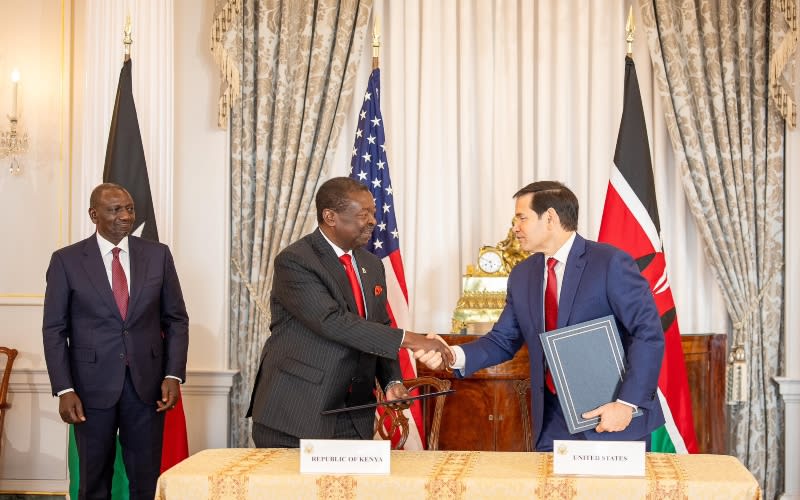
The Court of Appeal has cleared the way for the implementation of Kenya’s health cooperation framework with the United States, overturning orders that had temporarily blocked the agreement as a constitutional challenge against it continues.
In a ruling delivered on Friday, October 9, 2026, the appellate court set aside the High Court’s conservatory orders, allowing the government to proceed with the framework pending the determination of the appeal.
“We are of the considered view that public interest favours the implementation of the programme pending hearing of the appeal," Justices Munyao Sila, Johnson Okoth Okello and Lady Justice Jacqueline Kamau ruled in part.
The decision has drawn attention to the potential impact of the dispute on approximately 1.4 million Kenyans who could be affected by disruptions to healthcare services, including treatment programmes for HIV, tuberculosis and malaria.

"It would negatively impact the provision of critical treatment to 1.4 million Kenyans who depend on the drugs and Health care support system that will be provided by the Framework," the court further ruled.
The government had argued that maintaining the suspension could disrupt essential health services, jeopardise resources and expose patients to potentially serious consequences if treatment and other critical programmes were interrupted.
The government had argued that maintaining the suspension could disrupt essential health services, jeopardise resources and expose patients to potentially serious consequences if treatment and other critical programmes were interrupted.
The judges considered these risks in deciding whether implementation should remain suspended while the legal battle continued. However, the ruling does not conclusively determine whether the framework is constitutional or resolve the concerns raised in the substantive case.
Why Omtatah challenged the agreement
The legal dispute stemmed from a challenge by Busia Senator Okiya Omtatah, who questioned whether the Kenya-US health framework complied with the Constitution and other Kenyan laws.
Among the issues raised was whether the agreement required parliamentary ratification and whether it could create financial obligations or commitments involving public resources without the necessary legislative approval.
Omtatah also argued that the arrangement raised concerns about the division of responsibilities between the national and county governments, potentially touching on functions assigned to counties under Kenya’s devolved system.
Another major issue was the protection of sensitive health information. The senator questioned whether the framework complied with the Data Protection Act and argued that a data protection impact assessment had not been conducted before its execution and implementation.
These concerns placed the agreement at the centre of a wider debate about healthcare financing, executive authority, parliamentary oversight and the protection of patients’ personal information.
The Court of Appeal’s decision to lift the orders does not mean these questions have been conclusively settled.
Why the court allowed implementation
In challenging the High Court’s decision, the government argued that suspending the framework could undermine essential healthcare programmes and threaten the continuity of services relied upon by millions of Kenyans.
It also warned that resources could be redirected elsewhere if implementation remained blocked, potentially complicating efforts to sustain the programmes supported by the arrangement.
The appellate judges found that the government’s intended appeal raised arguable legal issues that warranted further consideration. These included questions about how the High Court handled the proceedings, with the government challenging the circumstances under which the application was heard.
The appeal also raised concerns about a similar pending case and whether the proceedings presented a sub judice issue.
The court’s decision allows the government to proceed while these legal questions remain subject to further determination.
Data privacy and Parliament’s role under scrutiny
Beyond healthcare, the case raised questions about the safeguards required when international agreements involve public resources, regulatory obligations and sensitive personal data.
The parliamentary approval question was particularly significant because Omtatah argued that the framework could create obligations requiring legislative scrutiny.
The data protection concerns also highlighted the need for appropriate safeguards when arrangements involve the handling or processing of patients’ health information.
However, the ruling does not establish that the agreement violates data protection law or that patients’ information has been improperly shared. Those issues remain part of the wider legal dispute.
What happens next?
The decision removes the immediate legal barrier created by the High Court’s conservatory orders, allowing the government to proceed with implementation as the challenge continues.
"Essentially, we order that pending the hearing and determination of the intended appeal, the ruling and orders of the High Court of December 19, 2025, which granted conservatory orders in terms of Order No. 1 at paragraph 58 of the ruling, are hereby set aside," the three-judge bench ruled, though pending the determination and ruling of the matter, which the court reserved for October 30.
The substantive proceedings could still determine whether the framework meets constitutional requirements relating to parliamentary oversight, public expenditure, devolution and data protection.
For patients, the immediate concern is continuity of healthcare services that the government argued could be affected by a prolonged suspension. For the government, the ruling provides temporary relief from the restrictions imposed by the High Court.