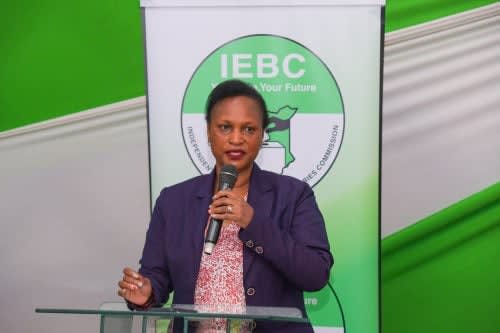
The Independent Electoral and Boundaries Commission (IEBC) has clarified that Kenyans seeking to contest for president, governor or Member of Parliament in the 2027 General Election are currently not required to hold a university degree.
IEBC Commissioner Ann Nderitu explained that the position follows court rulings that declared the degree requirement under the Elections Act unconstitutional. As a result, the commission cannot enforce the qualification during the nomination process.
“As we start now, there is no requirement for a degree for anybody. That's the situation we are in,” Nderitu said during an interview on Citizen TV.

The clarification opens the door for aspirants without university degrees to contest for the affected elective positions, provided they satisfy all other constitutional and statutory eligibility requirements.
Among the requirements candidates must meet are Kenyan citizenship, registration as voters, nomination by a political party or eligibility to run as independent candidates, and compliance with leadership and integrity provisions. Additional requirements may apply depending on the elective position.
Nderitu noted that the degree requirement had previously been challenged in court, with petitioners questioning the constitutionality of requiring university qualifications for candidates seeking the presidency, parliamentary seats and governorships.
She explained that the courts considered Article 27 of the Constitution, which guarantees equality and freedom from discrimination, alongside Article 10, which provides for public participation in the formulation of laws and policies.
The courts also considered the proportion of Kenyans with university degrees, with Nderitu citing the 2019 Census figure of 3.5 per cent. According to her, the ruling found that enforcing the requirement could effectively bar the remaining 96.5 per cent of Kenyans from contesting for key elective positions.
“According to the ruling, it means that the rest of the Kenyan 96.5 per cent cannot participate in elections for governor, for president and for member of parliament. Meaning then, that is discriminatory,” she said.
Nderitu explained that the degree requirement could be reinstated in future, but only through a lawful legislative process that gives the public an opportunity to participate and present their views.
“Unless now, maybe somebody will go to court, or we then start the process of public participation and now allow the degree process now to come through the proper public participation,” she said.
She emphasised that the court's decision does not mean the Constitution lacks provisions relating to educational qualifications. Rather, Parliament is mandated to prescribe the requirements governing eligibility for elective offices.
Nderitu maintained that until a valid new requirement is enacted, a university degree will not be among the qualifications required for presidential, gubernatorial and parliamentary candidates in the 2027 General Election.
“But a degree, as we start now, is not part of the requirement,” she said, adding that aspirants must continue to satisfy all other constitutional and statutory eligibility conditions.
